









Thirteen drone flights between late June and early December document a full dairy farm construction cycle — from the first steel columns to covered corridors connecting finished barns, all closed in before deep winter.
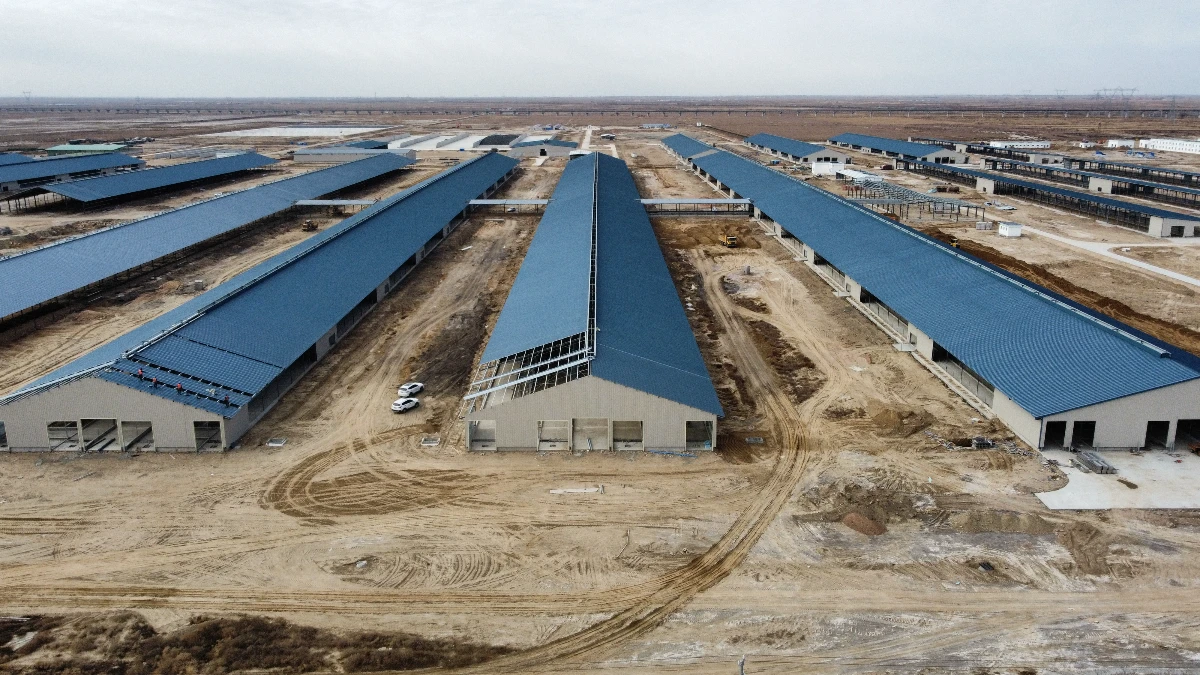
When a large dairy farming group in northern China needed to bring a new production base online before winter, the construction method was effectively decided by the calendar. Conventional concrete construction could not have closed the envelope before sub-zero temperatures arrived. A Fertigbau-Landwirtschaftsgebäude system could — and the thirteen drone photos in this article, taken between late June and early December 2023, show exactly how it was done, month by month.
At the client’s request we are not publishing the operator’s name, herd size or precise location. What we can show is the build itself: more than a dozen prefab agricultural buildings — clear-span cattle barns several hundred meters long, concrete-walled silage bunkers with steel canopies, a feed center and connecting corridors — taken from bare ground to full enclosure in about five months.
Project snapshot
| Location | Northern China — cold-winter plain, high snow & wind design loads |
| Sector | Dairy farming / livestock housing |
| Scope | 12+ buildings: clear-span cattle barns, silage bunkers, feed center, covered corridors, support facilities |
| Structure | Hot-rolled H-section portal frames, galvanized C/Z purlins, corrugated steel roof & wall cladding |
| Site timeline | First columns late June → full enclosure early December (≈5 months) |
| Foundations & walls | Cast-in-place concrete piers, stem walls and silage bunker walls by local contractor, in parallel with steel fabrication |
Why large dairy operations choose prefab agricultural buildings
Dairy housing is an unforgiving application. Barns must be long, wide and open — cows, feed lanes and machinery all need uninterrupted floor area — yet the building also has to breathe, shed snow, and stand up to ammonia-laden humidity year after year. A prefabricated steel portal frame answers all three requirements at once, which is why it has become the default structural system for modern livestock complexes worldwide.
- Parallel workflows compress the schedule. While the local civil contractor poured foundations and concrete stem walls on site, the steel frames, purlins and roof sheets were fabricated off site. Erection began the moment foundations cured — no idle weeks.
- Clear spans keep the floor plan open. Portal frames carry the roof to the perimeter columns, so feed alleys, cubicle rows and scraper systems can be laid out without internal columns interrupting them.
- Repeatability multiplies the saving. A complex like this one repeats near-identical barns many times. Once the first frame design is engineered and approved, every subsequent steel cattle barn reuses the same fabrication drawings, jigs and erection sequence — each building goes up faster than the one before it.
- Open-sided design delivers natural ventilation. High eaves, open sidewalls and a ventilated ridge create constant cross-flow — the single most important factor for herd health and summer milk yield.
Five months of dairy farm construction, documented by drone
The sequence below is the actual photographic record, in chronological order. Watch for one pattern throughout: at any given moment, different buildings on the site are at different stages — frames here, purlins there, roofing beyond. That staggered pipeline is what lets one set of cranes and crews deliver a dozen prefab agricultural buildings in a single season.
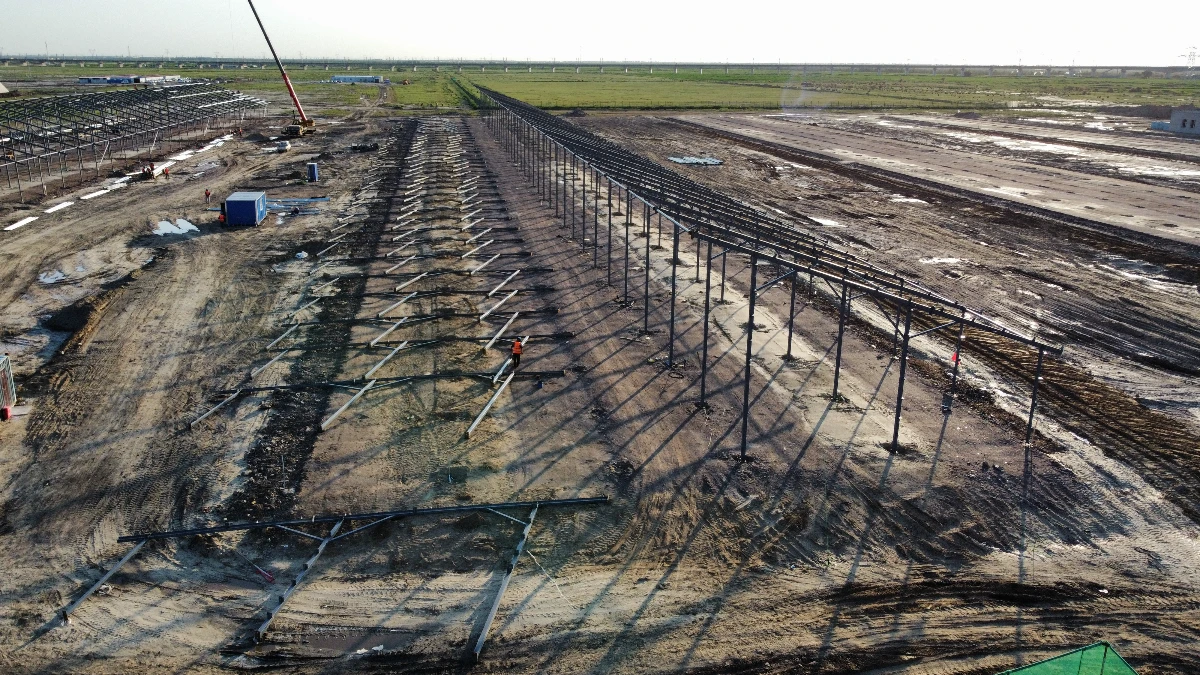
Late June — Steel frame erection begins
Erection started while parts of the site were still being graded. One barn’s primary frames already stand in a continuous row; the next building’s members are laid out on the ground in assembly order. Pre-sorting steel on the ground is what lets a small crane crew raise an entire bay in hours.
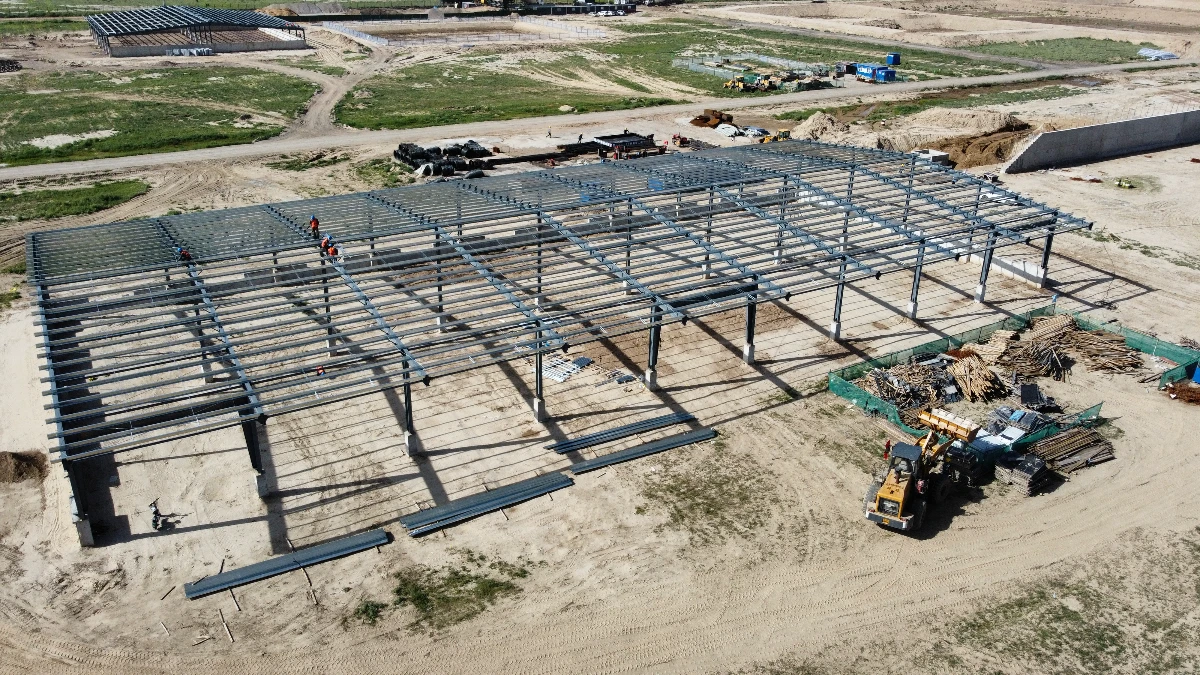
Early July — Purlins go on the first building
Days later, the first structure carries its full grid of galvanized purlins — the secondary steel that ties the frames together and carries the roof sheets. Workers walking the frame lines give a sense of scale: each bay spans wide enough for a loader to turn inside.
Mid July — Crane crews scale up across the site
With the first building proven, erection spread down the site. A single mobile crane services multiple rows of frames, walking the access road between them — a layout decision made at the design stage, not on site. Frame rows hundreds of meters long rise within the same week.
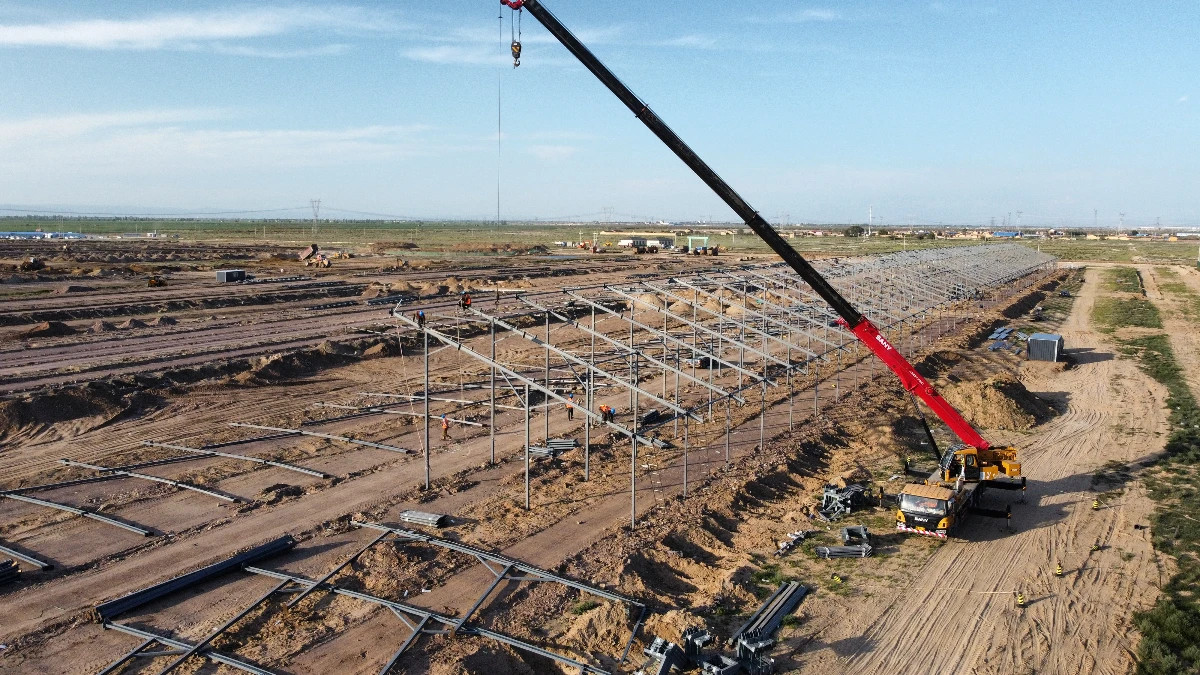
Late July — The first roof goes on
Roofing early in the sequence is deliberate: a covered building becomes weather-independent workspace, so interior work continues regardless of summer rain. Note the concrete stem walls below the steel — standard in a livestock steel building, where the wall base must resist impact and daily wash-down.
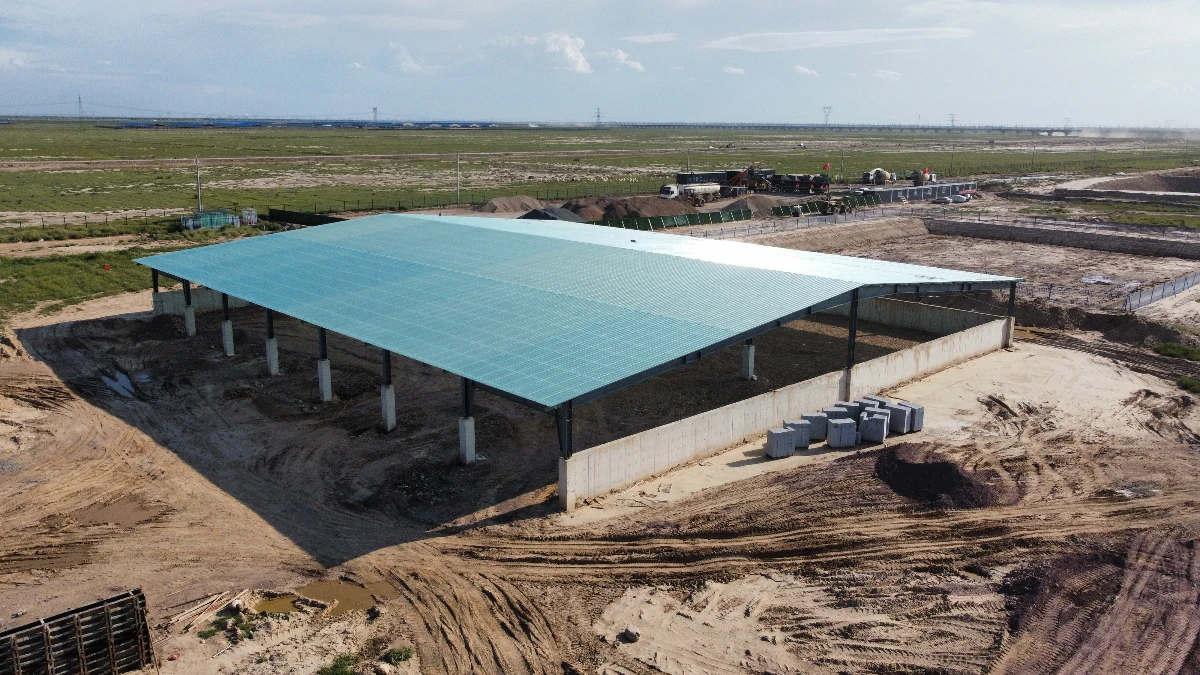
Early August — Three barns roofed, utilities trenched
Five weeks in, three full-length barns stand roofed while excavation runs between them — drainage, water and power going into the ground while the structures above are already finished. In conventional construction these trades queue; in prefab dairy farm construction they overlap.
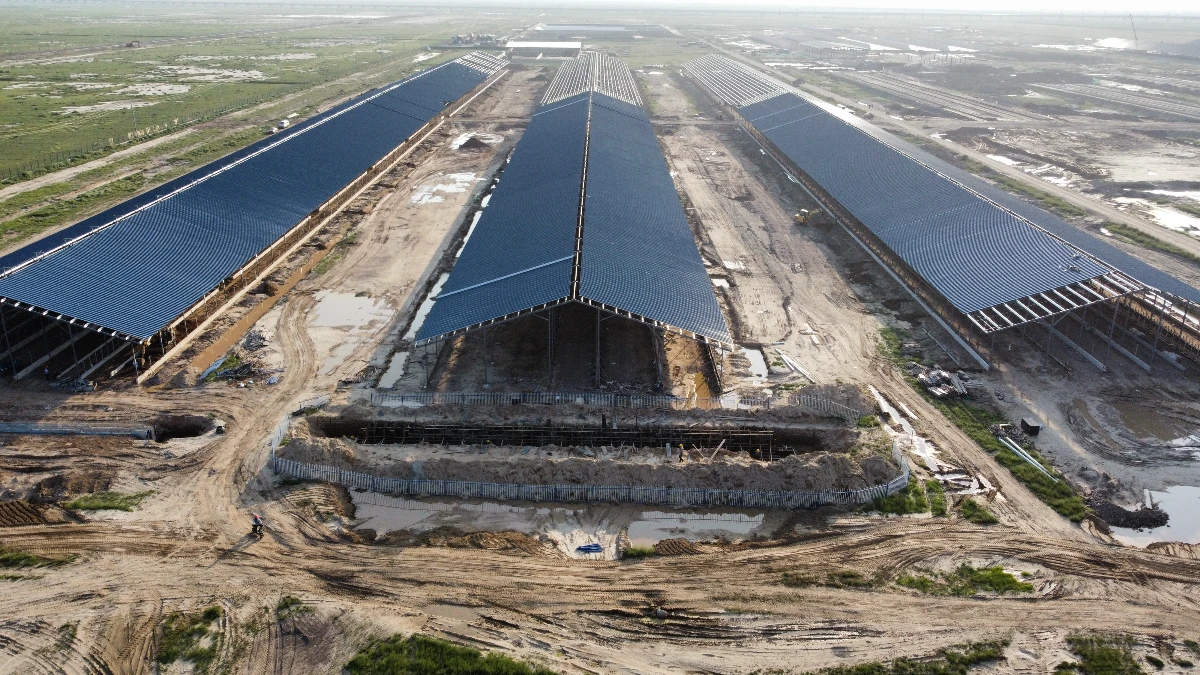
Mid October — Silage bunker construction
Attention shifted to the feed side of the operation: silage bunkers with cast-in-place concrete walls, capped by a prefabricated steel canopy to keep precipitation off the feed face. The same prefab logic applies — concrete cures on site while the steel above it is fabricated elsewhere, then the two meet in a single erection window.
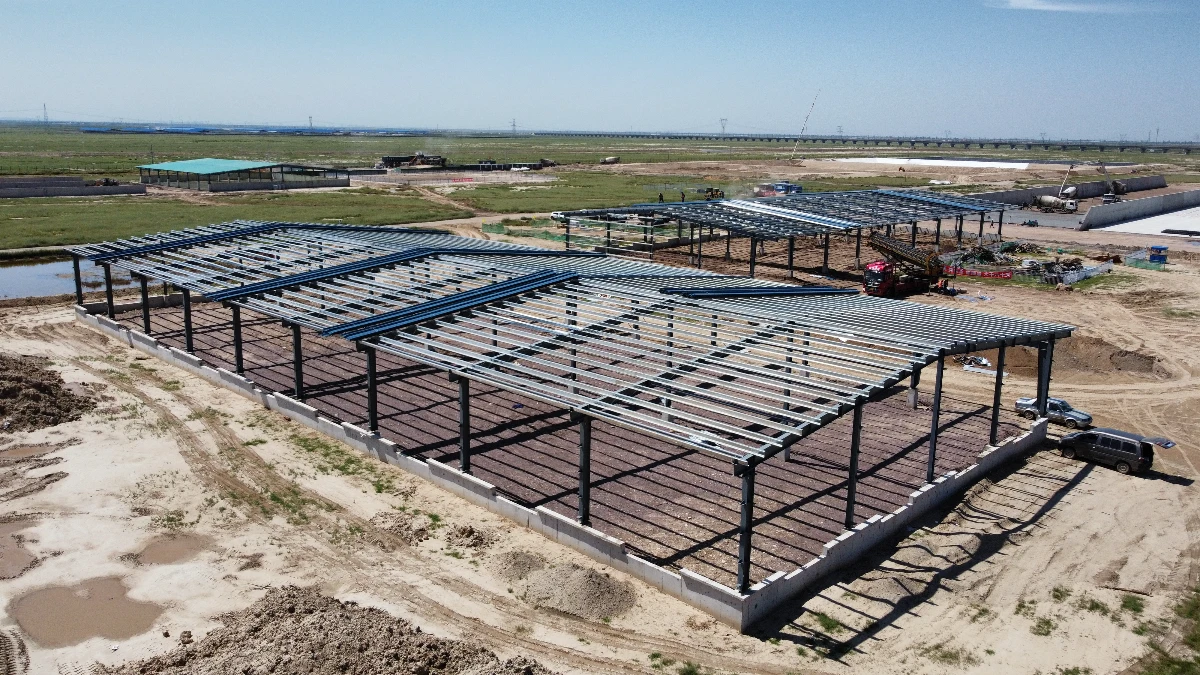
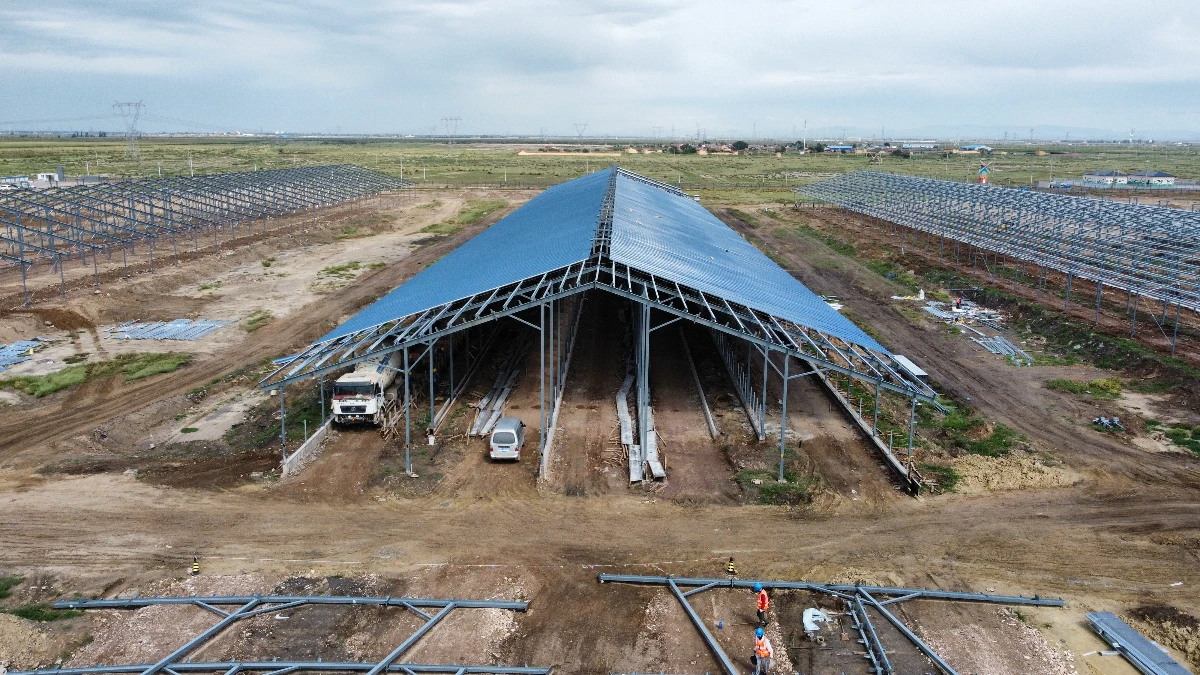
Late August — A clear-span gable line takes shape
Looking straight down a barn’s gable end shows what the system is for: a clear-span interior with no internal columns between the perimeter lines, wide enough for feed trucks to drive through. Roof sheeting advances from the ridge outward while vehicles already use the building below.
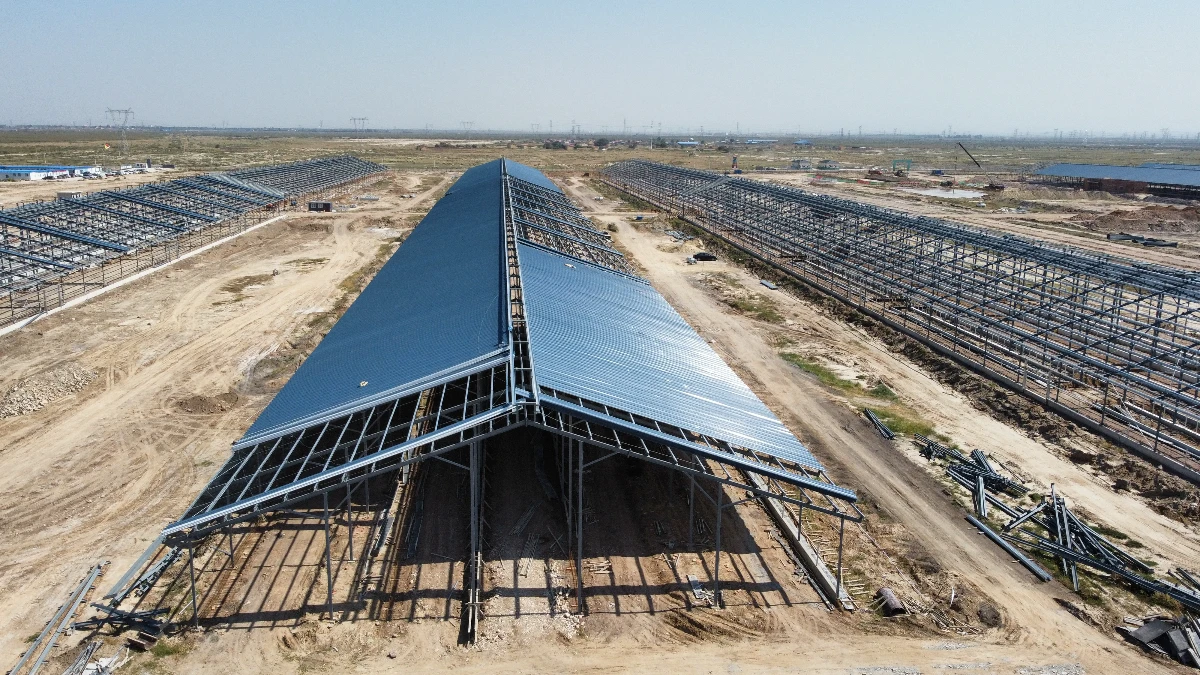
Mid September — Roofing the long spans
September belonged to the roofing crews. The photo below catches a barn at the halfway point — finished sheeting behind, bare purlins ahead — flanked by the skeletons of the next row. Each steel cattle barn roof covers several thousand square meters and goes on in days, not weeks.
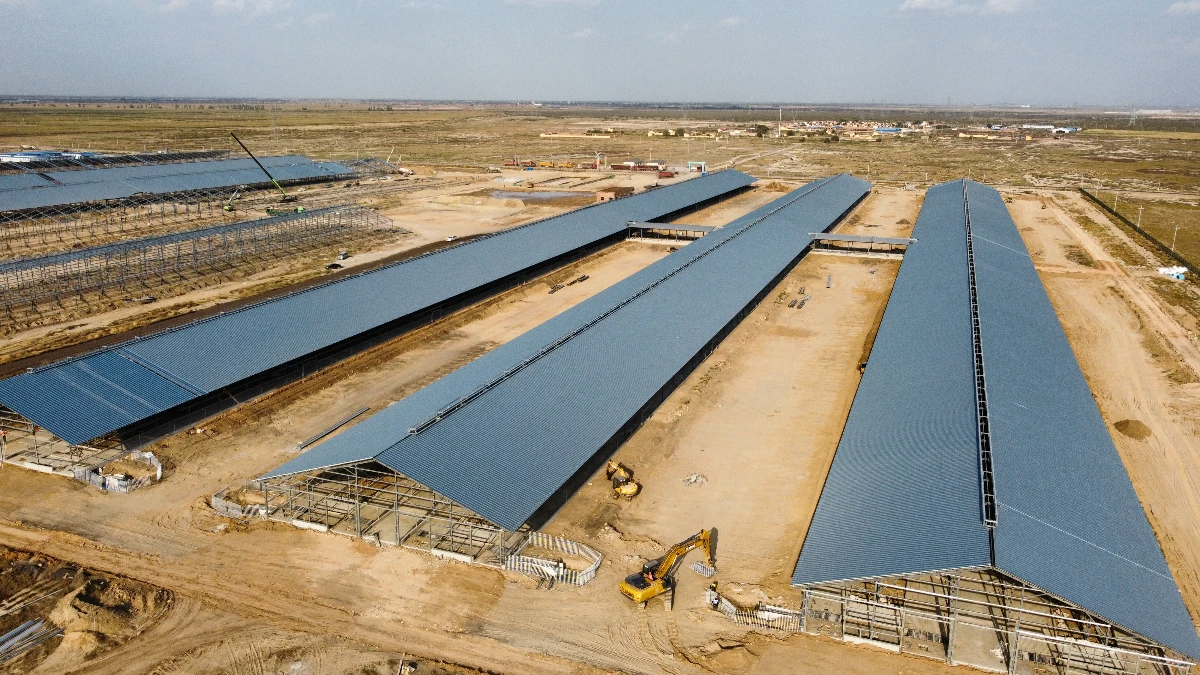
Late September — The first cluster nears completion
Three months after the first column, an entire cluster of barns stands roofed with gable frames closing in. Earth-moving equipment has shifted from structural work to site finishing — grading the yards and lanes between buildings.
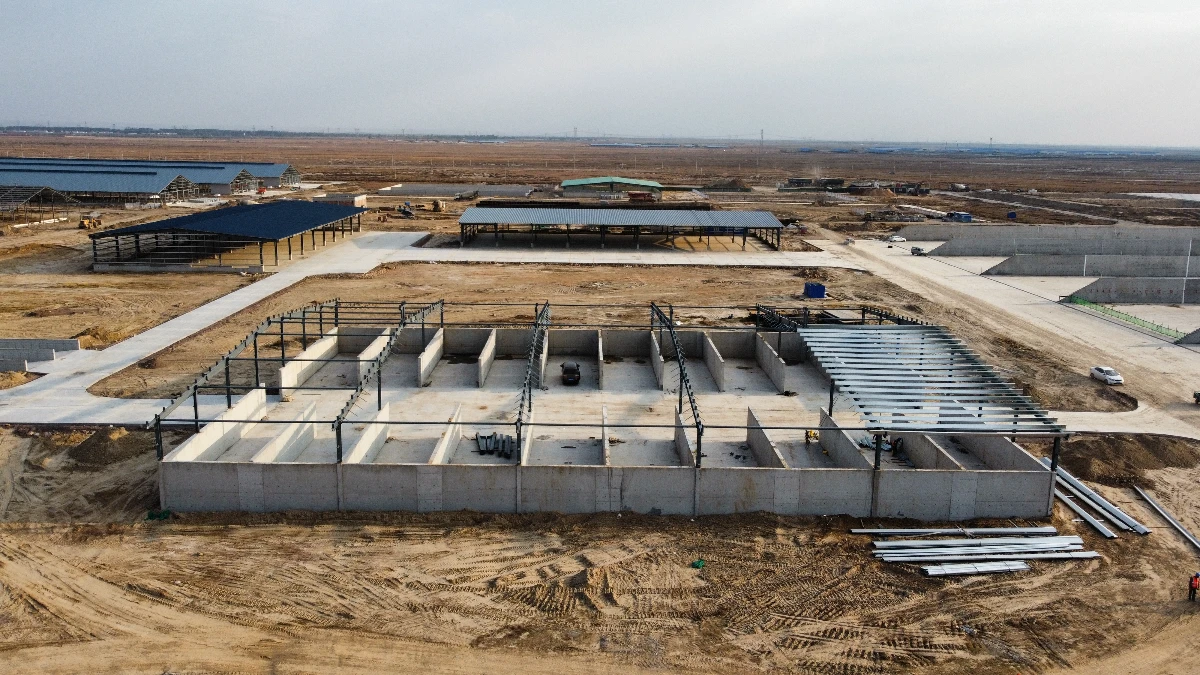
Mid October — Silage bunker construction
Attention shifted to the feed side of the operation: silage bunkers with cast-in-place concrete walls, capped by a prefabricated steel canopy to keep precipitation off the feed face. The same prefab logic applies — concrete cures on site while the steel above it is fabricated elsewhere, then the two meet in a single erection window.
Late October — End walls and cladding
With roofs complete, crews turned to the building envelopes: cream wall cladding, gable end walls with vehicle doors, and the trims that close every junction. This is also when each barn starts to look like the drawings — and when the complex starts to function as a farm rather than a construction site.
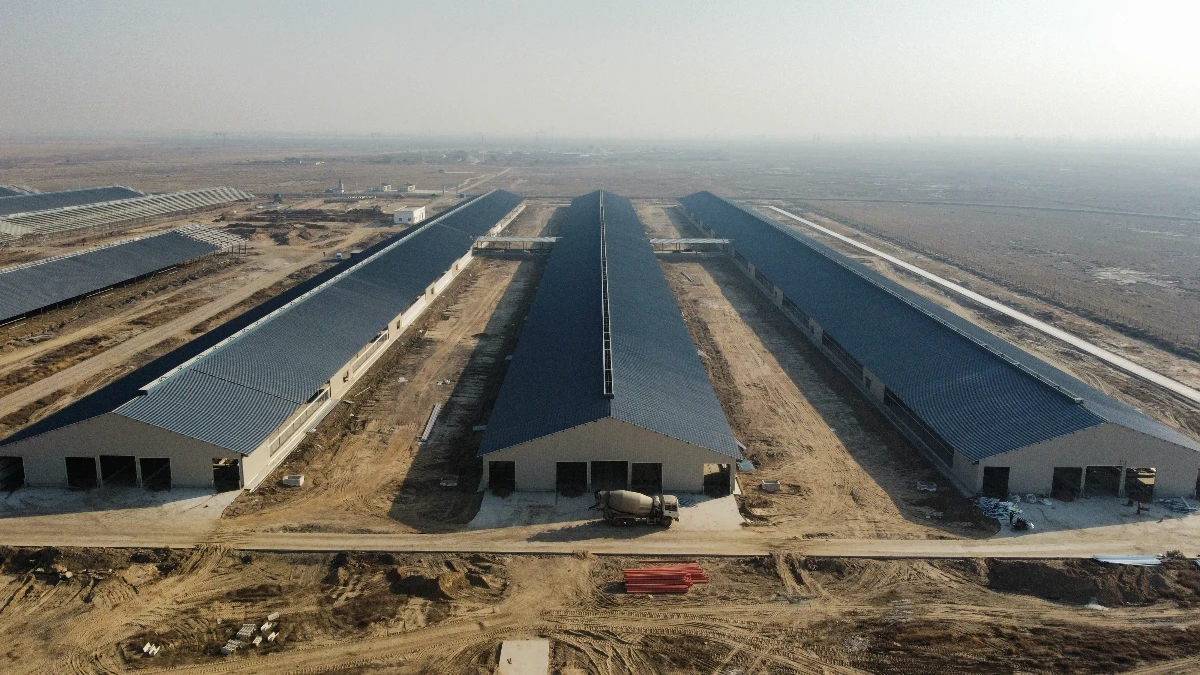
Early November — Cladding across the whole complex
The wide view shows how far a season’s work reaches: barn rows clad and closed in the foreground, later phases still in frames at the site’s edge. Every building visible here started as flat ground in June.
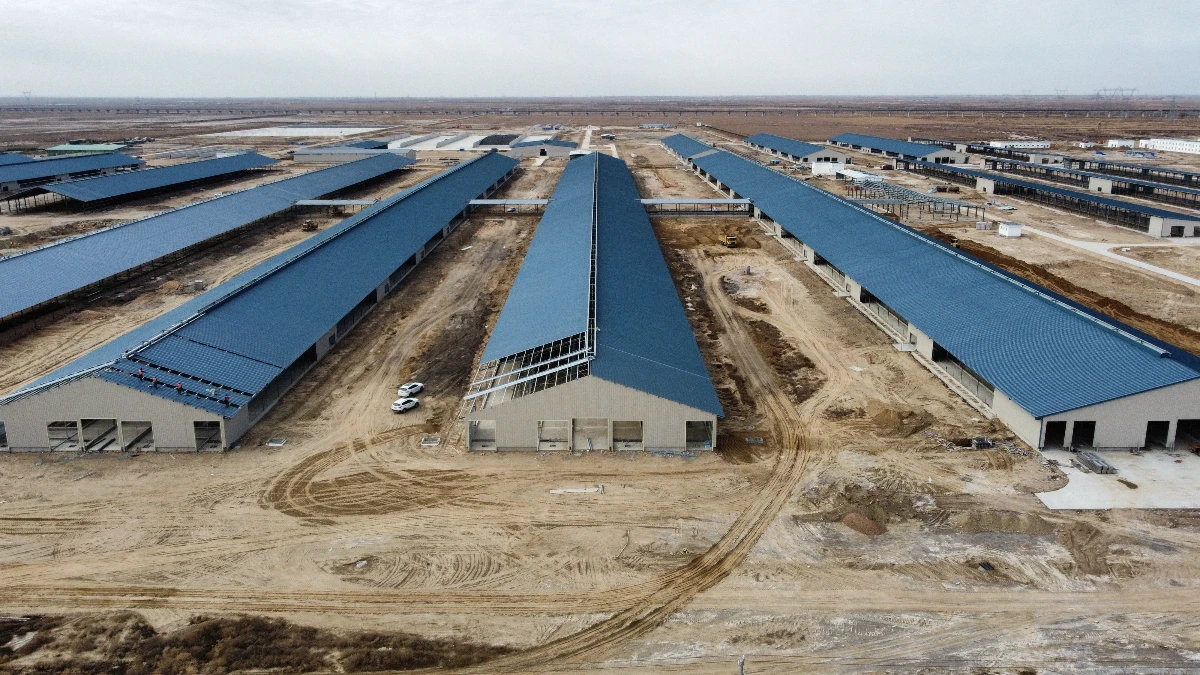
Early December — Covered corridors close the loop
The final connections: covered corridors linking barn to barn, so animals and feed move under roof in winter weather. With these in place the complex was essentially weather-tight — enclosed, as the schedule demanded, before deep winter set in.
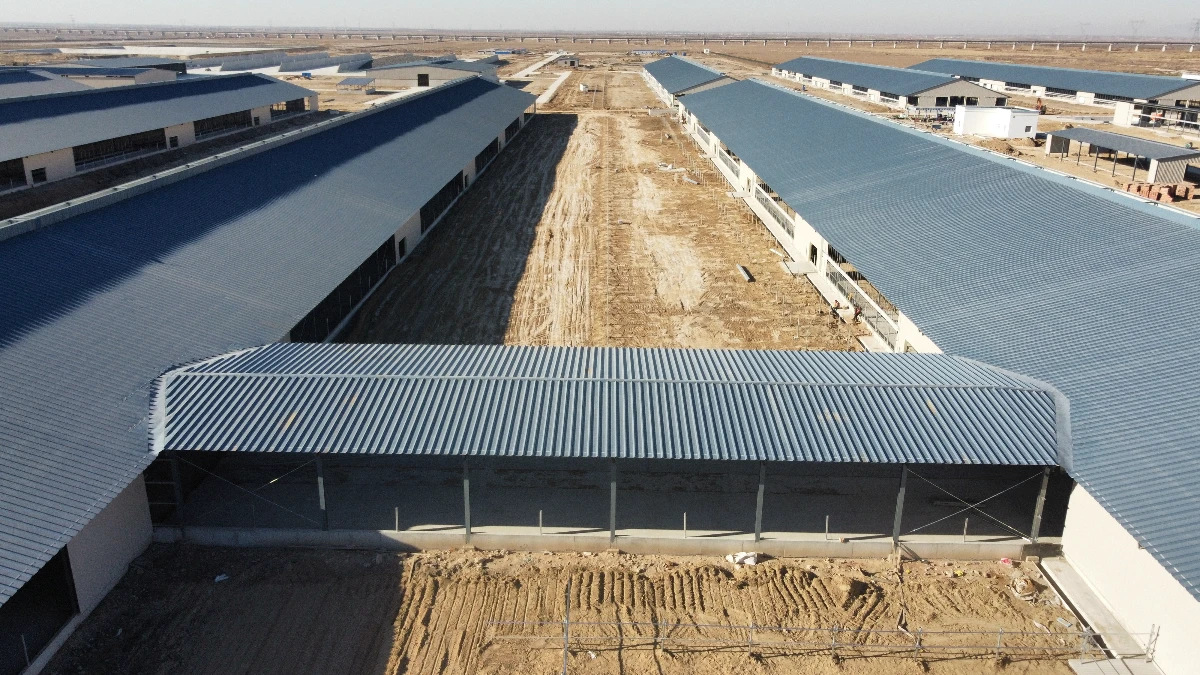
Anatomy of a livestock steel building: details that matter
A barn is not a warehouse with animals in it. Several decisions visible in these photos are worth calling out for anyone planning a similar facility:
- Ventilation is designed, not hoped for. Eave heights, ridge openings and sidewall openings were sized for cross-ventilation at the herd’s stocking density — in cold climates the goal is air exchange without draft at animal level.
- Concrete where the cows are, steel where they aren’t. Stem walls and bunker walls take the abrasion, impact and daily wash-down; the steel structure above is kept out of the splash zone, dramatically slowing corrosion.
- Coatings specified for an ammonia environment. Galvanized purlins and a paint system selected for persistent humidity and ammonia exposure — the quiet difference between a 15-year barn and a 30-year barn.
- Snow and wind loads from the actual site. Northern-plain winters drove heavier purlins, closer spacing and additional bracing bays compared to a temperate-climate barn of the same span. Every export project we quote is engineered the same way, to the destination country’s loads and codes.
- Logistics designed into the layout. The access roads between barn rows were sized as crane paths first and farm lanes second — one reason a single crane could erect the whole site.
Planning your own agricultural steel building project?
The system shown here is not specific to dairy. The same portal-frame platform — adapted in span, height, ventilation and cladding — is what we ship worldwide for poultry houses, pig barns, sheep sheds, grain storage, machinery sheds and processing buildings. If your operation is weighing a Fertigbau-Landwirtschaftsgebäude against conventional construction, the questions that decide it are usually the same three this client faced: how fast do you need enclosure, how open does the floor need to be, and what will the building endure for the next 25 years.
Explore our agricultural building solutions and prefab steel building systems, or browse more project deliveries to see the same platform in other sectors.
Tell us your location, building use and rough dimensions — within 24 hours you’ll receive a preliminary prefab agricultural building design with structural sections sized to your local snow and wind loads, no obligation. Request a free quote →