










VIKKINS has completed the cold chain warehouse construction for the Qiqihar Integrated Logistics Park in Heilongjiang, China — delivering a full cold storage building envelope across 20,000 m² of temperature-controlled space. The scope covers insulated sandwich panels for all walls and ceilings, cold room panels for individual freezer chambers, and a complete steel structure cladding system for the exterior facade. All components were supplied, installed, and verified by VIKKINS from factory to final airtightness check.
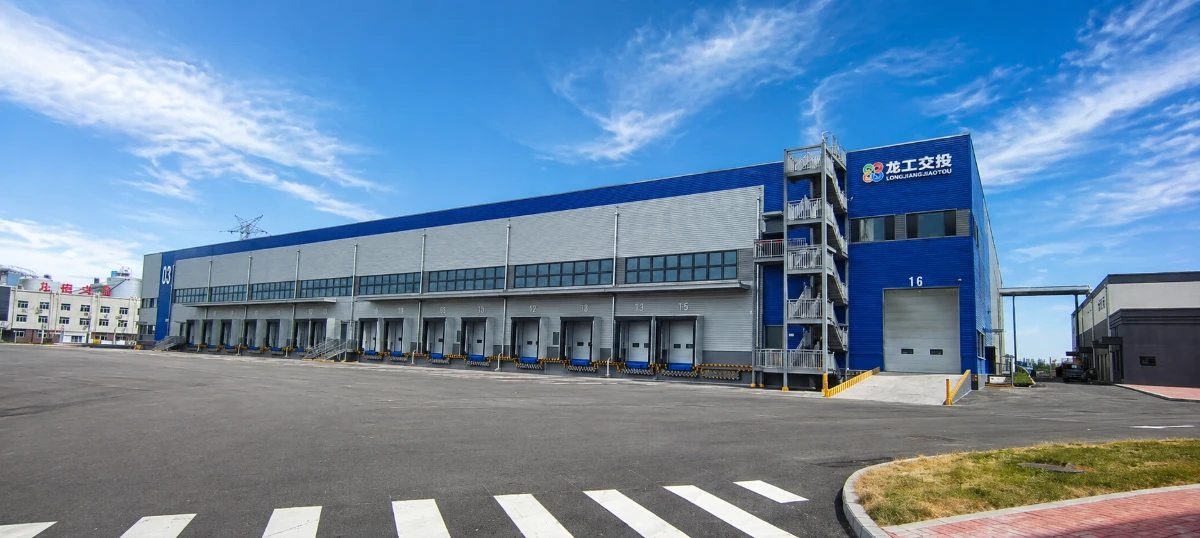
Insulated Sandwich Panels: Core Thermal System
The primary insulation element throughout the facility is VIKKINS’ rigid polyurethane (PU) core insulated sandwich panels, applied across all wall and ceiling surfaces at panel thicknesses ranging from 150 mm to 200 mm depending on the design temperature of each zone.
Panel construction: Each panel consists of two pre-painted galvanized steel face sheets continuously bonded to a high-density, closed-cell PU foam core under controlled factory conditions. This manufacturing process — continuous double-belt lamination — ensures uniform foam density and a void-free bond between core and facings, which is critical for consistent thermal performance across the full panel area.
Thermal performance: Closed-cell PU foam achieves a thermal conductivity of λ ≈ 0.022–0.024 W/m·K, among the lowest of any commercially available rigid insulation material. At 150 mm thickness, this yields a U-value well below 0.15 W/m²·K — sufficient for deep-freeze operation down to −25°C without supplementary insulation layers.
Vapor control: In cold storage environments, vapor drive is reversed relative to standard construction: warm, moist external air constantly attempts to migrate inward through the envelope. Closed-cell PU foam has extremely low vapor permeability (µ > 60), effectively acting as an integral vapor barrier and eliminating the risk of interstitial condensation or ice formation within the panel assembly over the building’s service life.
Joint system: Panels are connected using a tongue-and-groove locking profile, which achieves an airtight mechanical seal at every joint. This detail eliminates thermal bridging at panel connections — a known failure point in older hook-and-cam systems, where joint gaps develop progressively through repeated thermal cycling.
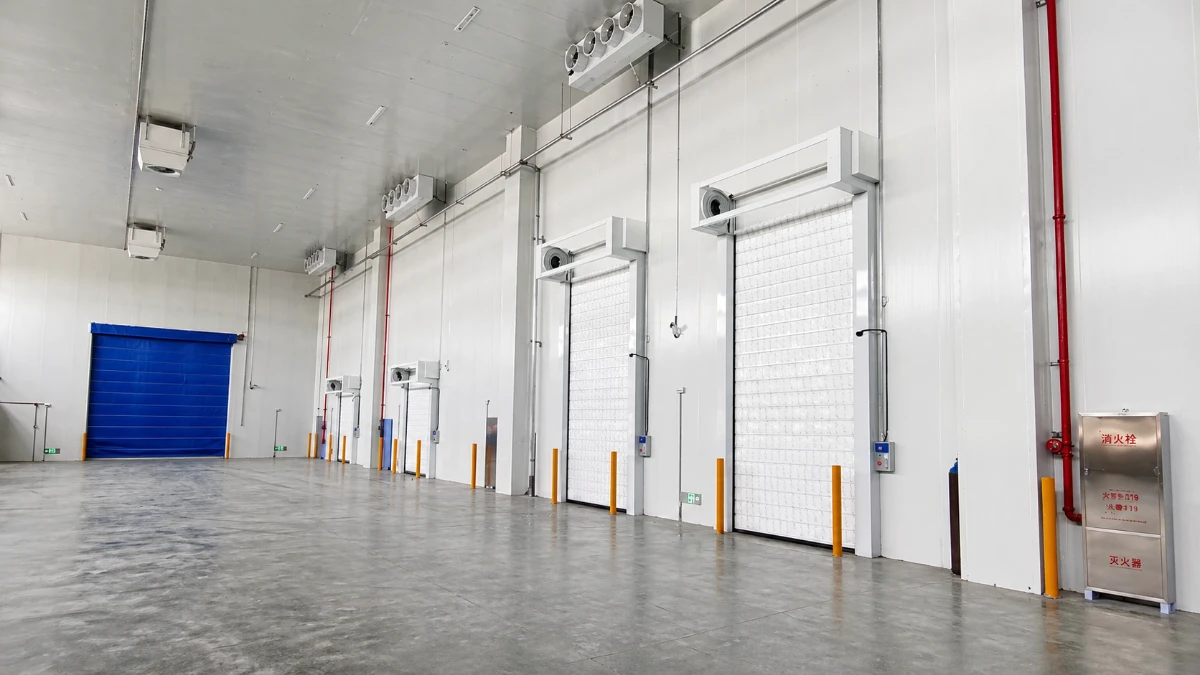
Cold Room Panels: Chamber-Level Performance
Individual refrigerated chambers within the facility are lined with cold room panels selected for the specific operating temperature of each zone. The facility includes both chilled zones (+2°C to +10°C) and deep-freeze chambers (−18°C to −25°C), each requiring a different panel specification:
| Zone Type | Operating Temp | Panel Thickness | Core Density |
|---|---|---|---|
| Chilled storage | +2°C to +10°C | 150 mm | 40 kg/m³ |
| Deep-freeze storage | −18°C to −25°C | 200 mm | 42 kg/m³ |
Cold room panels at the deep-freeze chambers are fitted with recessed joining profiles that allow panel faces to sit flush at the interior surface, eliminating protruding ledges where ice can accumulate and where cleaning equipment can cause impact damage during routine maintenance cycles.
Door interfaces: Each cold room panel assembly terminates at a purpose-profiled door frame section that integrates directly with the insulated sliding door unit. The continuity between panel insulation and door frame insulation is maintained without interruption, preventing the localized cold bridging that commonly develops at door perimeters in less carefully detailed systems.
Steel Structure Cladding: Exterior Envelope Design
The building exterior is finished with VIKKINS’ color-coated steel structure cladding in a two-tone grey and cobalt blue profile, consistent with the Longjiang Jiaotou Group’s facility branding. Beyond visual identity, the cladding system performs several technical functions:
Weather barrier: The profiled steel sheets lap and interlock to direct rainwater clear of panel joints, protecting the insulated envelope from moisture ingress at the building skin.
UV and corrosion resistance: The steel substrate is hot-dip galvanized (Z275 coating weight) prior to PVDF color coating, providing long-term corrosion resistance appropriate for Qiqihar’s humid continental climate with cold winters and significant seasonal temperature swing.
Thermal movement accommodation: Color-coated steel cladding expands and contracts with ambient temperature change. Fixing details use slotted holes at intermediate fixings, allowing the sheet to move longitudinally without inducing buckling or loosening fasteners at the panel face.
The facade incorporates a continuous band of translucent polycarbonate roof lights along the upper wall zone of the ambient buffer hall, providing natural daylight to the operational floor without compromising the thermal integrity of the cold storage zones behind.
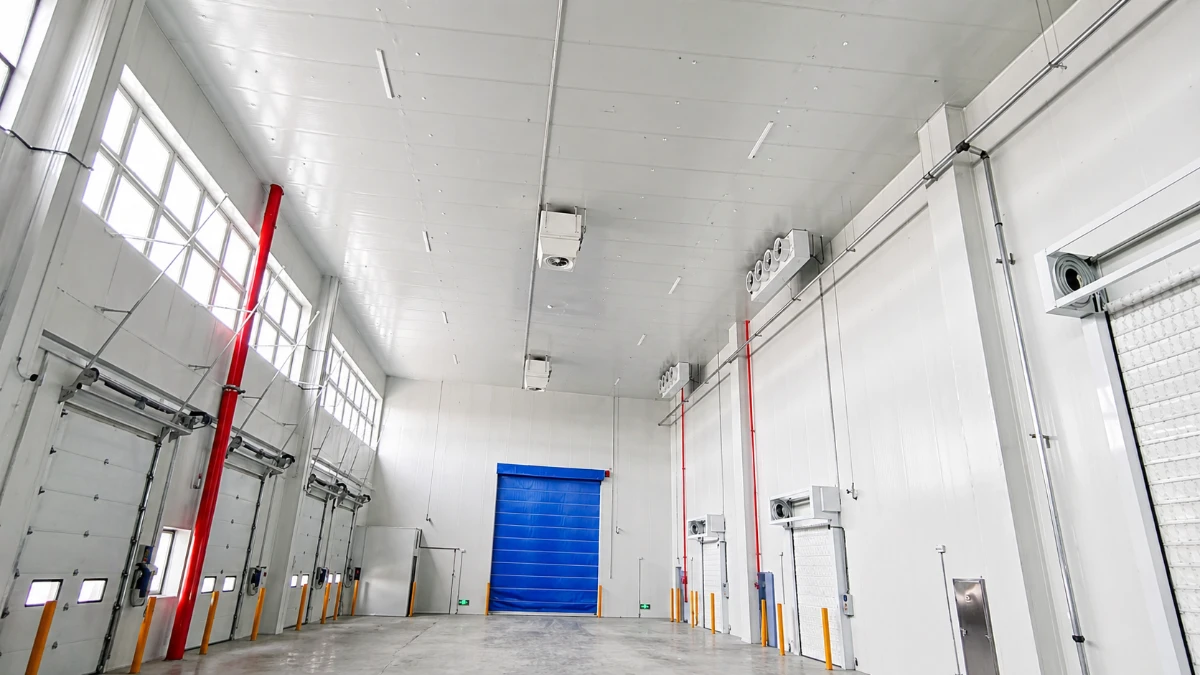
Cold Storage Building Envelope: Integrated System Performance
The cold storage building envelope at this facility is engineered as a continuous, uninterrupted thermal shell — not a collection of independently specified components. VIKKINS coordinated the interface between wall panels, ceiling panels, floor perimeter upstands, door frames, and exterior cladding to ensure thermal and vapor continuity at every junction.
Key envelope interface details include:
Wall-to-ceiling junction: A purpose-formed internal corner section maintains panel insulation continuity at the wall-ceiling intersection. The corner profile is foamed-in-place on site after panel installation to fill any residual gaps before the internal finish angle is applied.
Floor perimeter upstand: Cold room wall panels extend below finished floor level and bear onto a continuous insulated upstand block, isolating the cold slab from the ground-bearing slab and preventing ground frost heave — a structural risk in sustained deep-freeze operation that is frequently overlooked in lower-specification cold store construction.
Roof penetrations: All refrigeration pipework, electrical conduit, and drain penetrations through the roof and wall envelope are sleeved with closed-cell foam insulation and sealed with low-vapor-permeability mastic, maintaining the vapor barrier integrity of the PU panel system at every service penetration point.
Cold Chain Warehouse Construction: Project Execution
The cold chain warehouse construction program at Qiqihar was executed in a single continuous installation sequence, coordinated with the primary steel structure contractor to allow panel installation to proceed zone by zone as structural bays were released.
VIKKINS provided on-site technical supervision throughout the installation phase, covering:
- Panel handling and storage protocols to prevent face sheet damage prior to installation
- Joint sealing sequence and sealant application standards
- Fixing torque specifications for panel-to-structure connections
- Airtightness testing procedure at practical completion, using tracer gas methodology to verify envelope continuity before refrigeration plant commissioning
Total installation duration from first panel to envelope completion: 11 weeks across a 20,000 m² scope.
Project Data Summary
| Parameter | Detail |
|---|---|
| Project | Qiqihar Integrated Logistics Park – Cold Chain Facility |
| Location | Qiqihar, Heilongjiang Province, China |
| Client | Longjiang Jiaotou Group |
| Total Panel Area | 20,000 m² |
| Panel Core Material | Rigid closed-cell polyurethane (PU) |
| Wall/Ceiling Thickness | 150 mm (chilled) / 200 mm (deep-freeze) |
| Thermal Conductivity | λ ≈ 0.022–0.024 W/m·K |
| Temperature Zones | +2°C to +10°C / −18°C to −25°C |
| Exterior Cladding | PVDF color-coated galvanized steel |
| Installation Duration | 11 weeks |
| Completion | July 2024 |
Specifying insulated sandwich panels or cold room panels for an upcoming project? Contact VIKKINS for thermal calculations, panel selection guidance, and project-specific quotation!
For international cold chain construction standards, refer to the Global Cold Chain Alliance (GCCA) technical guidelines.